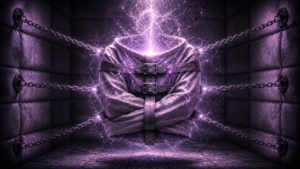
I want to credit Tony Sayers for originally describing the physical body as a “straitjacket” that is constraining the consciousness of the soul. The analogy immediately resonated with me, and I couldn’t think of a better one: a straitjacket doesn’t remove our capabilities; it restricts our ability to access and express them.
I realise this may be sacrilegious to New Agers, where there is so much emphasis on venerating the body. But that insistence is precisely what makes me question it. When any spiritual teaching tells me what I must regard as sacred rather than encouraging me to examine it for myself, my discernment kicks in.
We want to remember more of what we are as souls and expand our consciousness and perception far beyond the limitations of this reality. But we do not experience this incarnation as disembodied consciousness. Our consciousness interfaces with a biological body equipped with a nervous system designed, in my opinion, to do two things: keep us physically alive and keep us spiritually enslaved.
And that obviously creates tension.
We may be ready to expand beyond everything we have previously known, while the nervous system is still asking: is this safe?
This is why nervous-system regulation cannot be separated from shadow work or spiritual development. Protector parts can keep the nervous system activated by constantly scanning for danger and triggering its alarms and the nervous system influences how much intensity, uncertainty, visibility, intimacy, pleasure, energy, information and change we can receive without becoming overwhelmed. It affects whether we can remain present as our consciousness expands—or whether our survival responses cause contraction and pull us back towards what is familiar.
In that sense, the nervous system becomes a gatekeeper to expansion—or, as I see it, a straitjacket. Its priority is survival, not self-actualisation.
The “Reptilian Brain”: Survival Before Expansion
You may have heard of the reptilian brain: the primitive part of the brain concerned with instinct, survival, territoriality and automatic behaviour. The term comes from neuroscientist Paul MacLean’s twentieth-century “triune brain” model, which divided the brain broadly into a reptilian complex, a mammalian or limbic system, and the neocortex. While modern neuroscience debates this, it serves as an effective metaphor for our ancient survival circuitry.
From my perspective, however, I have come to wonder whether the reptilian association goes deeper than metaphor. Within the Matrix, reptilian entities are an artificially created, non-ensouled intelligence—one of the principal entity races involved in the control system surrounding Earth. They are parasitic upon human beings and souls, feeding upon the fear, trauma and emotional energy generated within the system while participating in the wider spiritual enslavement of consciousness.
This makes the symbolism of the “reptilian brain” intriguing to me. The very circuitry associated with fear, survival and automatic reaction is also the circuitry through which a human being can be most easily kept dysregulated, reactive and disconnected from conscious choice. Whether that correspondence is literal, symbolic or something we do not yet understand, I find it interesting, but more on that later.
Given our ancient survival circuity, there are systems within us constantly evaluating our internal and external environment for potential threats. They operate largely outside conscious awareness and can mobilise the body before the thinking mind has even understood what is happening.
This is important because the nervous system does not only respond to what is objectively dangerous. It responds to what it has learned to associate with danger.
For example, if being visible once resulted in ridicule, visibility may feel dangerous, if expressing your needs resulted in rejection, authenticity may feel dangerous. And so we can consciously want expansion while another part of us is pulling the emergency brake.
The Nervous System Doesn’t Ask What We Want as a Soul, It asks: Is this safe?
That distinction explains so much. We sometimes call ourselves self-sabotaging when we repeatedly move towards something we want and then inexplicably retreat. But what appears to be sabotage may sometimes be protection.
Your conscious mind might say, I want to be seen, while your nervous system is responding to a subconscious shadow programme that remembers when being seen got us hurt. Consciously, you want expansion; subconsciously, your system is still protecting you from it.
This is why changing our thoughts does not always change our lives. Without inner work, our conscious intentions can remain in conflict with the subconscious programmes running beneath them.
The conscious intention can be expansion while the body remains organised around survival. This is one of the reasons why shadow work to rewire the mind and nervous system is so essential for spiritual development.
The Body as a Straitjacket for Consciousness?
Shadow work aside, I do believe the human body in its current form functions less as the natural expression of the soul and more as a biological straitjacket for consciousness.
Various esoteric and alternative cosmologies have proposed versions of the idea that consciousness has become restricted through embodiment.
What if the limitations of the human brain and nervous system are not the limitations of consciousness itself, but the limitations of the interface through which consciousness is being expressed?
Imagine taking something vast, multidimensional and potentially capable of perceiving far beyond ordinary human awareness, then squeezing it into an interface dominated by survival, sensory limitation, biological drives, fear responses, attachment needs and almost complete amnesia about what it was before arriving here.
The soul has not necessarily become smaller. It has been strapped into something that severely restricts its range of movement.That is what I mean by a biological straitjacket.
Spiritual awakening is the experience of consciousness beginning to push against the straps.
What If the Body Became the Straitjacket?
More contemporary theories go further, suggesting that the human biological form may have been modified from an original design in ways that reduced our capacity to access, receive and express the full spectrum of consciousness available to us by creating a human organism more heavily dominated by survival, fear and limitation.
There is no established scientific evidence that the human body was deliberately engineered or modified to imprison consciousness, so I offer this as a hypothesis rather than fact.
But as a thought experiment, it raises a fascinating question: What if the degree of limitation we currently experience was not part of the original design? This is what resonates most strongly with me as a soul: I believe the original human form has been tampered with to serve the agendas of those who operate the Matrix.
If the human body is the natural vehicle for soul consciousness, why does so much about its design seem to work against the soul remembering and expressing itself? We arrive with little or no memory of what we are, leaving us to identify with the body and personality. We perceive only a narrow bandwidth of reality and inhabit a nervous system that prioritises survival over expansion. Fear contracts us, trauma fragments us, and the biological need to belong can make authentic expression feel like a threat to survival. The very vehicle through which the soul experiences this reality seems engineered to make us forget we are the soul.
How much of what we experience as the limitation of our consciousness is actually the limitation of the biological interface? And if that interface were modified, perhaps the most effective containment system imaginable would not require visible walls. It would simply convince consciousness that the limitations of the interface were the limitations of itself.
Your Window of Tolerance
One useful psychological concept here is the window of tolerance: the range of nervous-system activation within which we can remain sufficiently regulated to think, feel, connect and respond rather than becoming overwhelmed.
Within this window, we can experience and tolerate uncertainty. We can remain curious. We can receive new information without immediately defending against it. We can experience a challenge without automatically interpreting it as catastrophe.
When something exceeds our capacity, however, we may move outside that window and our nervous system can move through several states.
Parasympathetic: Rest and Digest
When we feel sufficiently safe and regulated our body can rest and digest, we have greater access to curiosity, connection, creativity, discernment, play and flexible thinking.
We are not necessarily constantly calm, but regulation means having the capacity to experience activation without losing yourself inside it. You can become angry without becoming consumed by anger. You can feel fear without allowing fear to make every decision.
There is enough internal capacity to remain present. And presence changes everything.
Fight: I Need to Defeat the Threat
When the sympathetic nervous system mobilises us for defence, we may experience anger, agitation, irritability, muscular tension, racing thoughts, increased heart rate and an overwhelming impulse to act. Fight energy is not inherently unhealthy. We need access to aggression in its healthy form: boundaries, self-protection, determination and the ability to say no. Problems arise when the nervous system becomes chronically organised around threat and begins fighting dangers that are no longer present.
Flight: I Need to Escape
Flight is another mobilisation response. It can look like anxiety, restlessness, hypervigilance, overthinking, compulsive productivity, inability to sit still or the persistent feeling that we should be somewhere else, doing something else, solving something else.
Freeze: I Cannot Fight and I Cannot Escape
When neither fighting nor fleeing feels possible, the system may immobilise. Freeze can involve feeling stuck, overwhelmed, disconnected or unable to act despite consciously knowing what we want to do. This can be particularly confusing because the mind may interpret immobilisation as laziness or failure. But repeatedly berating ourselves for not moving can create even more perceived threat. Sometimes the question is not why can’t I make myself do this? It is what about doing this does some part of me experience as unsafe?
Shutdown: I Need to Conserve Everything
At the more collapsed end of the spectrum, we can experience extreme withdrawal, brain fog, numbness, disconnection and depleted energy. The system moves towards conservation.
And this matters enormously when we talk about energy. Because sometimes what we describe as having “low energy” is not only a lack of motivation. A body that has spent prolonged periods anticipating, responding to or recovering from threat has been allocating enormous resources towards survival.
You cannot indefinitely run an emergency response without it taking a heavy energetic toll.
Nervous System Regulation
A healthy nervous system is flexible. It mobilises when mobilisation is required and settles when the threat has passed. We want access to fight when a boundary needs defending. We want access to flight when something genuinely needs escaping. We want the ability to become intensely activated by excitement, creativity, sexuality, exercise and challenge. And then we want the capacity to return.
Nervous system health is not the absence of activation, but the ability to move through it without becoming trapped there. Our survival responses are not the problem; the problem is when the nervous system becomes stuck responding to the present through the imprint of the past, or when our circumstances keep us locked in survival mode.
Survival Mode Keeps the Straitjacket Tight
Whatever we believe about the origins and evolution of the human body, we know that survival states affect perception. When the organism perceives danger, attention narrows. Threat becomes more salient.The unfamiliar can become suspicious. Resources are redirected towards immediate protection.Curiosity and flexible thinking can diminish. Everything becomes organised around one fundamental question:
What do I need to do to survive?
If the ordinary biological interface already filters consciousness, chronic survival mode constricts our available awareness even further. The straitjacket tightens. Pay the bill. Avoid rejection. Watch for danger. And consciousness becomes consumed with surviving the immediate human experience. The extraordinary becomes inaccessible because the organism is preoccupied with surviving the ordinary.
It Is No Coincidence the Matrix Keeps Us in Survival Mode
The Matrix is structured in ways that keep the human nervous system chronically activated. From my perspective, this serves its agenda on two fronts: generating its favourite flavour of low-vibrational loosh while simultaneously containing consciousness. If you wanted to limit consciousness, keeping the biological interface through which it expresses itself perpetually preoccupied with survival would be an effective way to do it.
Keep people worried about money. Make shelter and basic provisions dependent upon constant income. Manufacture scarcity. Keep them exhausted. Bombard them with information and an endless stream of threats and crises. Scatter their attention through technology. Make rest feel unproductive and productivity a measure of worth. Keep them consuming, comparing, competing and striving—perpetually wondering whether they have enough, are enough or are falling behind.
The nervous system rarely receives the message: You are safe now. You can stop scanning. You can expand. Instead, it is continually told: Keep going. Keep watching. Keep working. Something could happen. You could lose what you have. You are not safe yet.
The consequences of this are not incidental. A soul whose human nervous system is consumed by survival has considerably less bandwidth available for contemplation, creativity, intuition, discernment, questioning the nature of reality or remembering that it may be far more than the identity it has been given.
Survival keeps consciousness looking down rather than looking beyond.
The Matrix does not need to physically imprison the soul if it can keep consciousness contracted through the body. The cage becomes physiological. The bars are fear, scarcity, exhaustion, hypervigilance and dysregulation. And the person experiencing them may assume that this is just what being human feels like.
This is why I believe nervous-system regulation can become something far more than “self-care.” It can become an act of reclaiming consciousness. If the Matrix tightens the straitjacket through fear and survival, regulation may be one of the ways we begin loosening its straps.
The Energy Cost of a Dysregulated Nervous System
Imagine having fifty browser tabs running continuously in the background. Even when you are not consciously looking at them, they are consuming resources. Chronic hypervigilance can operate similarly. A nervous system constantly scanning for danger is using energy. Suppressing emotions uses energy. Maintaining protective parts uses energy. Constant muscular bracing uses energy. Rumination and overthinking uses energy. People-pleasing uses energy. Monitoring everyone else’s emotional state uses energy. Remaining perpetually prepared for something to go wrong uses energy.
As we resolve the patterns that keep telling the body the emergency is still happening, some of that energy can become available again. Available for creativity. For curiosity. For connection. For sexuality. For play.For intuition. For purpose. For being fully alive.
Why Expansion Can Feel Dangerous
We tend to think that the nervous system only becomes activated by things we don’t want. But positive expansion can also exceed our current capacity. More love. More money. More attention. Greater intimacy. Greater visibility. More responsibility. More pleasure. More creative energy. Greater psychic or intuitive sensitivity. A rapidly changing understanding of reality.
Many of us have a complicated relationship with receiving because, as children, we had little control over what we received, when we received it or whether our needs were met at all. Receiving could come with conditions, disappointment, obligation or strings attached, teaching us that receptivity makes us vulnerable. Society reinforces this by glorifying self-sufficiency and making asking for support feel weak, burdensome or shameful. We can also learn that to receive is to owe—that generosity creates a debt we will eventually be expected to repay.
Receiving asks us to relinquish control and trust that we are safe enough to have something without earning, chasing or suffering for it. If our worth has become tied to productivity, sacrifice or struggle, receiving can feel undeserved—even threatening. No wonder giving, striving and doing can feel safer than allowing ourselves to receive.
Even the fulfilment of something we have desperately wanted can destabilise us if it moves us too far beyond what our system currently recognises as normal. This is why I think capacity is a more useful concept than “raising your vibration.”
The question becomes: How much love can I receive without contracting? How much uncertainty can I tolerate without compulsively reaching for certainty? How visible can I become without unconsciously making myself small again? How much of my authentic expression can emerge before an old survival strategy tells me that belonging depends upon hiding it?
Expansion is not only about attaining higher states of consciousness. It is about increasing our capacity to receive, hold and embody them. This is why I no longer see nervous-system work as mundane compared with spiritual work. It is embodiment work.
The Nervous System and Authentic Expression
This becomes particularly important when we consider authenticity.
Many of the personalities we mistake for “who I am” were partly constructed around adaptation. The agreeable one. The achiever. The invisible one. The caretaker. The perfectionist. The hyper-independent one. The person who never needs anything..
These strategies may once have protected belonging, attachment or safety. But eventually the protection can become a prison. The authentic expression of the soul may want to move in an entirely different direction. It may want to speak. Create. Write. Leave. Begin. Love differently. Set boundaries. Take up space. Become visible. Question what everyone else accepts.
And suddenly authenticity itself becomes a nervous-system event.
Because becoming who we actually are may require us to stop performing the identity that once kept us safe.
Regulation, Discernment and Expanded Consciousness
Our nervous-system state also influences our perception. When we are deeply dysregulated, attention naturally narrows towards threat. We become more reactive. Ambiguity becomes harder to tolerate. The mind searches for explanations and certainty. And this matters enormously for spiritual discernment. Fear can feel like intuition. Hypervigilance can feel like heightened perception. Attachment to an outcome can influence what we believe we are sensing.
Regulation creates more internal space. Space between stimulus and response. Space between a thought appearing and believing it. Space between experiencing a sensation and constructing a story around it.
Space to ask: Is this actually true for me as a soul?
From the spiritual perspective, consciousness may extend far beyond the nervous system, but during this incarnation the nervous system profoundly influences how that consciousness is received, interpreted and expressed through the human experience.
The Nervous System as Both Gate and Gatekeeper to the Expansion of Consciousness
This creates an interesting paradox.
If the body does function like a straitjacket for consciousness, the obvious response might be to try to transcend it. But based on my experience, that may be precisely the wrong approach. If consciousness interfaces with this reality through the body, then the body may simultaneously be part of the limitation and the means through which we begin moving beyond it.
The Soul May Be Vast. The Human Container Still Needs Capacity.
Trying to force expansion while the body is signalling danger can create greater dysregulation. So instead, we expand our capacity. We regulate, resolve trauma, meet the shadow and alchemise the adaptations, limiting beliefs and survival strategies that keep us contracted. We stop abandoning ourselves to maintain belonging, learn to tolerate uncertainty and reclaim the energy consumed by hypervigilance and protection. This also means clearing energetic interference such as entity attachments and etheric technologies that may be perpetuating those states.
And gradually, the aperture may widen. What we call consciousness expansion is therefore not always about acquiring something we did not previously possess. It is about removing what has been restricting our access to what was already there.
Loosening the Straitjacket
The body needs repeated experiences that show it that circumstances which once meant danger may no longer mean danger now.That boundaries are safe. That rest is safe. That receiving is safe. That pleasure is safe. That visibility can be safe. That authenticity is safe. That uncertainty can be survived.
The nervous system learns through experience. The work is to update what it believes is possible—to teach the body that it no longer needs to organise our existence around fear, survival and protection. Little by little, what was once intolerable becomes tolerable; what felt unsafe becomes safe enough to experience. The container expands. More energy becomes available for expansion. We loosen the straps of the straitjacket from within—and the soul has space to emerge.