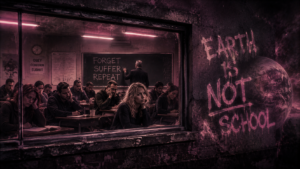
We’re told we came to Earth to learn lessons. That every experience—no matter how painful—is for our “highest good.” or is an “initiation into greatness” Grief is “the great transformer”. Trauma is a curriculum. That there are “no mistakes”—and if we don’t “learn the lesson,” we’ll just come back and repeat it.
But what if “Earth is a school” is the story that keeps the inmates from realising they’re in a prison?
Even when I subscribed to New Age beliefs, the notion that Earth is a school never made logical sense to me, but I had bought into it because it gave me something I needed: meaning for experiences that had otherwise haunted me as senseless tragedies.
Yet I still struggled to believe that enlightened souls would willingly subject themselves to such trauma, pain and suffering for lessons or spiritual evolution. It had even made me resent myself as a soul. What kind of sadomasochist would sign up for so much misery with such blatant disregard for the human embodiment who had to endure it?
I thought of a child subjected to years of horrific abuse, or a parent forced to watch their child die. Are we really going to look someone who has endured the unimaginable in the eye and tell them their soul chose it because it needed the lesson?
If Earth were truly a school, why would we enter each incarnation with our memories erased? Why would we begin by forgetting everything we had learned before?
No legitimate system of education works this way. Every meaningful form of learning builds upon what came before. A child must first learn the alphabet before they can recognise words, then learn words before they can read sentences, and learn to read before they can write. Each stage depends upon remembering the one before it. Memory is not an obstacle to learning; it is the foundation of it.
No teacher would erase a student’s memory at the end of every school year and expect them to progress to the next level. Nor would they repeatedly test students on lessons they have no memory of ever being taught.
We wouldn’t call that education. We’d call it a system designed to ensure the student fails—and is forced to keep repeating the same lessons.
New Age spirituality often counters this by claiming that remembering our previous lives would make “the game too easy.” But if we are genuinely here to learn and evolve, why would making that process harder be considered a virtue?
No teacher acting in a student’s best interests would deliberately withhold the very information they need in order to succeed. The purpose of education is to facilitate learning—not obstruct it.
The Earth-school narrative sells exploitation as education. It spiritualises pain and trauma while victim-shaming those who suffer in it. We are told that we chose these experiences before incarnating, or that they are necessary for our soul’s growth—even though we have no conscious memory of ever making those choices.
Underlying this is the New Age teaching that there is no objective good or bad, only our perception of events. Suffering, we are told, is not inherent in an experience but arises from how we choose to interpret it. Change your perception, and you change your reality.
Taken to its logical conclusion, this philosophy shifts the focus away from the act itself and onto the victim’s response. If an innocent child is being abused, is the problem really the child’s perception of the abuse? Should the child simply choose to experience it differently? Or is there something about the act itself that is inherently harmful, regardless of how anyone attempts to reframe it?
This places the burden on the victim rather than confronting the harm itself. Instead of asking why suffering exists, or who or what is responsible for causing it, we are encouraged to accept it, search for meaning in our pain, identify the lesson or resolve the karma, and ultimately conclude that we somehow created the experience ourselves.
In doing so, it transforms systemic dysfunction into divine purpose and persuades us that the more we suffer, the more we evolve.
I eventually realised that “Earth is a school” had never explained suffering. It had justified it.
And I had clung to that justification because the alternative—that my most painful experiences might have had no higher purpose at all—had been far harder to bear.
.And then there is karma.
When suffering can’t be explained as a lesson, karma provides another justification: we’re repaying debts incurred in previous lives we cannot remember.
But the same memory wipe creates an obvious problem. If we can’t remember what we did to incur the karma, we can’t know what we’re supposed to do differently. We can therefore unknowingly repeat the same actions, accumulating new karmic debt while attempting to repay the old.
So we enter each incarnation already carrying karmic debt, but with no memory of how we incurred it. The memory wipe doesn’t just conceal the debt—it creates the conditions for new debt to be created faster than the old can be cleared.
That isn’t a system designed to clear the debt. It’s a system in which the debt keeps renewing the sentence.
I explore karma more deeply in The Karma Con, but as an explanation for the Earth-school model, it doesn’t resolve the contradiction. It compounds it.
Just as the Earth-school model sets us up to fail lessons we cannot remember being taught, the karmic model sets us up to remain perpetually indebted for actions we cannot remember committing.
The incontrovertible contradictions within the “Earth is a school” narrative ultimately led me to conclude that Earth is NOT a school.
I now believe that souls are recycled through this Matrix not for their education or evolution, but to sustain it—as batteries and unconscious creators of this counterfeit reality, while the trauma and suffering experienced through their human embodiments generates loosh as a source of food for the parasitic AI entities within it.
From this perspective, the teachings that pain and trauma are necessary for our spiritual growth, reincarnation is essential for our evolution and karma must be repaid manufacture unconscious consent to our suffering, conditioning us to accept, endure and search for meaning within the prison rather than question the prison itself.
Meanwhile, karmic debt and unfinished lessons provide the coercion that binds souls to repeated incarnation.
Reincarnation is reincarceration—and “Earth is a school” is the false justification that makes the prison look purposeful.
Whether or not you accept that interpretation, it raises an important question:
Who benefits from humanity believing that reincarnation is necessary for our evolution—and that suffering is divinely ordained to serve some higher purpose?
Perhaps the greatest lesson isn’t contained within the suffering at all.
It’s recognising when a story has been designed to keep us consenting to the suffering—and coming back for more.